 Holdex
 DeFi development: Lending Products And Settlement
Last updated -
Holdex DeFi development combines lending-protocol engineering with product design, including the smart contracts and borrower-facing applications behind Clearpool. A lending product also needs rules for participation, interest calculations and the movement of funds. Those rules differ across Dynamic Pools, Clearpool Prime and Credit Vaults, even when they share application components. Holdex’s related work includes USDX integrations through Clearpool and Synnax’s credit-intelligence platform. The development questions concern who may lend or borrow, how a position earns interest and what permits repayment or withdrawal. A working interface must preserve those distinctions while showing the state of the selected pool.
Clearpool’s lending products require different access and repayment rules, so shared application code must preserve each product’s financial conditions.
From Credit Terms to a Working Application
Clearpool connects digital-asset lenders with institutional borrowing, giving Holdex’s product work a concrete scope across contracts, interfaces and their integrations. The selected lending model determines what the application must express. Borrowers need access to the terms governing funding, while lenders need understandable information about their resulting positions. Funding amounts, accrued interest and repayment obligations belong to that product experience.
Holdex built borrower and lender interfaces alongside Clearpool’s contracts. Its Credit Vaults work included the lender deposit interface and curator dashboard.
Access Rules Across Lending Markets
Participation rules determine which accounts a lending application may admit and which pools those accounts can use. Dynamic Pools offer permissionless lender access to whitelisted institutional borrowers. Clearpool’s app also imposes nationality and residence restrictions. Prime restricts participation to whitelisted institutions following identity and anti-money-laundering checks. Platform admission and permission to participate in a particular pool remain distinct conditions. Prime borrowers can select the lenders they accept, so the application must represent both levels of access.
A public Prime pool still belongs to a whitelisted platform; it does not offer unrestricted access to every wallet.
Credit Vault borrowers can choose permissionless or permissioned lender access for their pools. Borrowers still undergo KYC and anti-money-laundering checks, agree to the lending terms and receive a credit assessment. A reusable interface needs to display the permission model belonging to the selected pool, including restrictions applicable to its participants.
Utilization, Interest and Liquidity
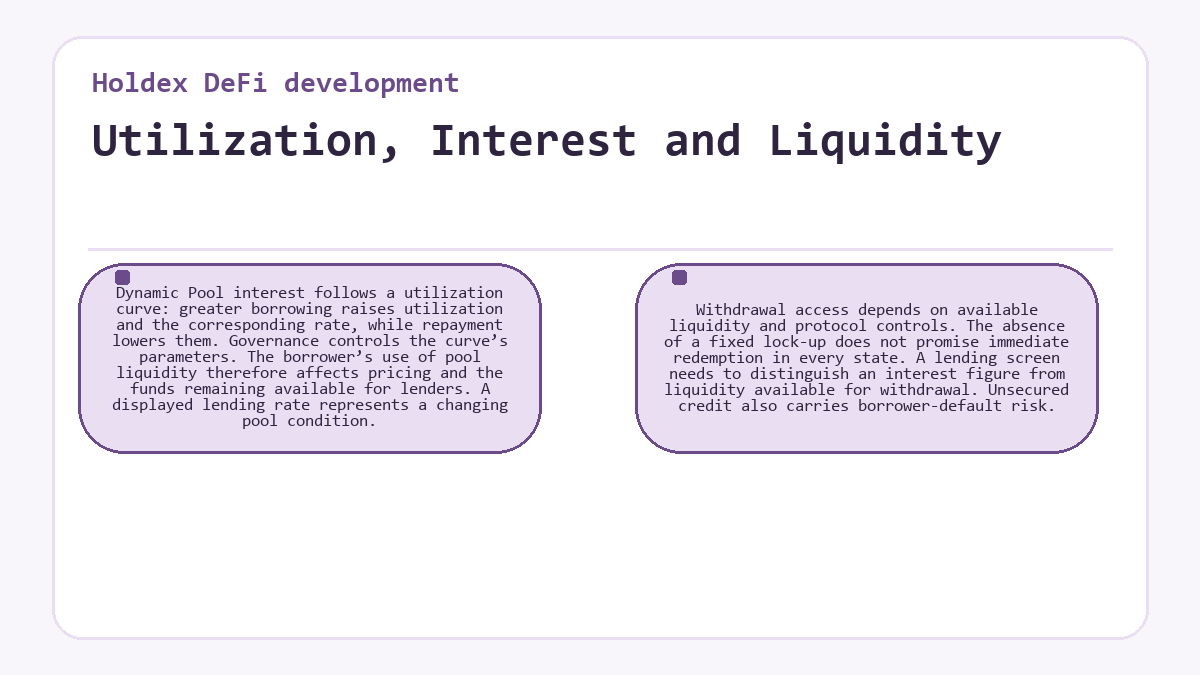
Dynamic Pool interest follows a utilization curve: greater borrowing raises utilization and the corresponding rate, while repayment lowers them. Governance controls the curve’s parameters. The borrower’s use of pool liquidity therefore affects pricing and the funds remaining available for lenders. A displayed lending rate represents a changing pool condition.
Withdrawal access depends on available liquidity and protocol controls. The absence of a fixed lock-up does not promise immediate redemption in every state. A lending screen needs to distinguish an interest figure from liquidity available for withdrawal. Unsecured credit also carries borrower-default risk.
Credit Vault Terms and Withdrawal Design
Credit Vaults govern withdrawal requests through pool-specific minimum notice periods and repayment frequencies. Lenders may request part or all of their position, subject to those timing requirements. Interest rates start with the borrower’s launch setting. A later increase can take effect without advance notice. Credit Vault borrowers must request a rate decrease at least two full notice periods in advance. The lower rate takes effect on the first repayment date after that advance-notice period. A replacement rate-decrease request restarts the notice period. The application needs to distinguish a pending rate change from a rate already in force.
Contracts and a Shared Application Layer
Holdex’s Clearpool implementation uses Solidity contracts and a Svelte application with a shared component library across several products. Reuse can keep recurring interface elements consistent while each product retains its own rules. A shared component does not imply identical permissions, withdrawal behavior or credit terms. The application still needs the correct contracts and state information for its selected deployment.
Settlement Assets and Custody Roles
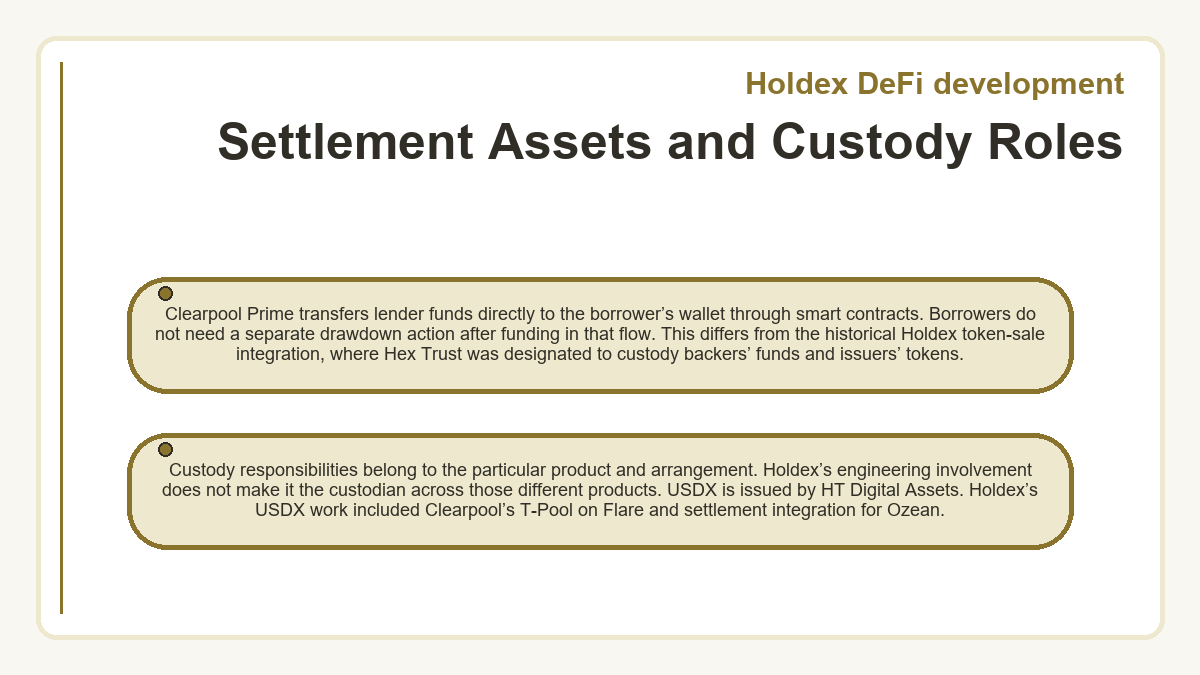
Clearpool Prime transfers lender funds directly to the borrower’s wallet through smart contracts. Borrowers do not need a separate drawdown action after funding in that flow. This differs from the historical Holdex token-sale integration, where Hex Trust was designated to custody backers’ funds and issuers’ tokens. Custody responsibilities belong to the particular product and arrangement. Holdex’s engineering involvement does not make it the custodian across those different products.
USDX is issued by HT Digital Assets. Holdex’s USDX work included Clearpool’s T-Pool on Flare and settlement integration for Ozean.
Credit Assessment and Private Company Data
Synnax provides a separate credit-intelligence example within Holdex’s portfolio, using machine learning and probability-of-default scoring to assess financial risk. Holdex led its design and product development. Synnax uses homomorphic encryption to protect private company data. Clearpool’s borrower-rating relationship with Credora is separate from this engagement.
Credit Vault Funding Compatibility
Credit Vault funding requires a supported wallet on the pool’s network. Can the current connection support the selected pool?
| Funding Parameter | Required State | Deposit Condition or Result |
|---|---|---|
| Wallet support | Supported wallet | Connection required for funding |
| Selected network | Chosen pool’s network | Network mismatch needs correction |
| Gas funding | Sufficient gas on that network | Enables transaction execution |
| Lending asset | Pool’s accepted asset on that network | Deposit amount must meet the pool’s minimum |
| Spending authorization | Protocol allowance approved in the wallet | Approval does not complete funding |
| Deposit status | Deposit transaction confirmed successfully | Pool-specific cpTokens received |
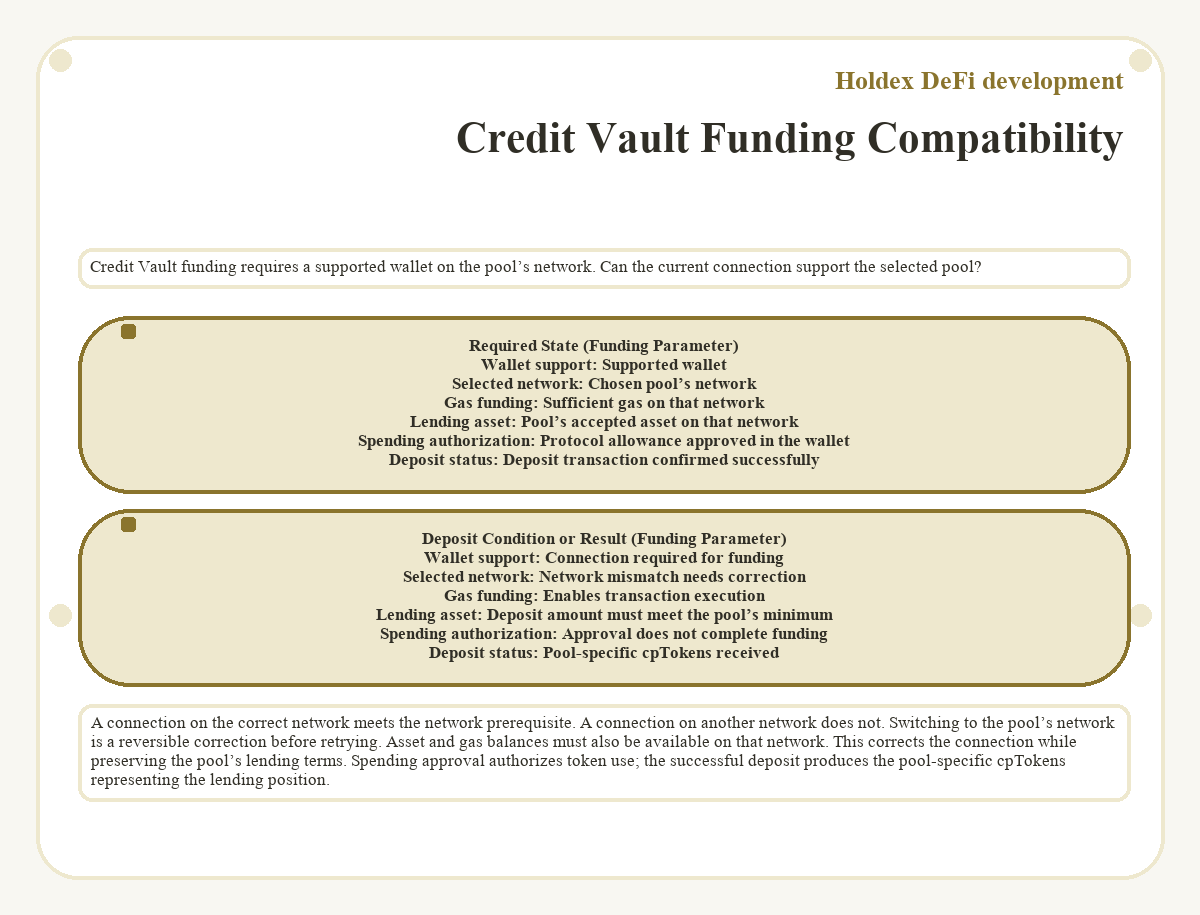
A connection on the correct network meets the network prerequisite. A connection on another network does not. Switching to the pool’s network is a reversible correction before retrying. Asset and gas balances must also be available on that network. This corrects the connection while preserving the pool’s lending terms. Spending approval authorizes token use; the successful deposit produces the pool-specific cpTokens representing the lending position.
Security Reviews and Deployment Scope
Clearpool publishes separate audit reports for Prime, Credit Vaults, the USDX T-Pool and other contract families. A review of one contract family does not automatically cover another deployment or a later change. Contract security and borrower creditworthiness also answer different questions. A correctly implemented loan can still remain unpaid.
Network selection belongs to the deployment scope too. Clearpool publishes contract addresses by network, so an application must use the addresses matching its intended deployment. An audit record, a credit assessment and the application’s active contract configuration each describe a different part of the lending product.
Fee Bases and Repayment Timing
Clearpool Prime charges borrowers an origination fee based on the amount raised and the applicable loan tenure. The calculation uses an annualized 360-day year and a standard 30-day month. Without a callback, the base origination fee uses the pool’s original tenure. An honored callback instead uses blocks elapsed up to repayment. Rolling a loan incurs an additional origination charge. The origination charge goes to Clearpool’s treasury when the borrower makes the final repayment, which includes principal.
Prime’s protocol fee diverts a governance-approved percentage of pool interest to the protocol treasury when the borrower initiates repayment. Penalty interest is excluded from that spread charge. Interest is the calculation base; applying the percentage to the full principal would produce a different charge.
A displayed annual percentage rate (APR) and the amount due at repayment describe different quantities. The interface needs the rate and its applicable accrual period.
Development Scope Beyond a Single Contract
A lending-development brief can separate contract changes from the borrower and lender experience it needs to support. Clearpool’s application work shows why permissions, position reporting and repayment terms extend beyond a contract function. Settlement integration and credit assessment introduce further responsibilities with different operators. A single contract change has a narrower scope than an engagement covering the application, integrations and continuing product engineering.
Useful questions about Holdex DeFi development
Can a Prime Lender Require Early Repayment Through a Callback?
A Prime callback requests early withdrawal and does not oblige the borrower to repay before maturity. If the borrower honors the request, interest is due only for blocks elapsed since the pool’s inception. A request alone does not establish repayment or completed withdrawal.
What Does a Dynamic Pool’s cpToken Represent?
A Dynamic Pool’s cpToken represents liquidity deposited in that particular pool together with accrued interest. The token is pool-specific, and redemption remains subject to pool liquidity. Its balance needs the corresponding pool context to describe the lender’s position accurately.
Which Clearpool Documents Did Holdex Help Produce?
Holdex co-authored the Clearpool Prime and Credit Vaults whitepapers and wrote the Prime user guide, extending its contribution beyond the contracts and application interfaces.
Does Prime Allow Every Pool to Extend Its Loan Term?
Prime’s rolling feature is limited to single-lender pools. It permits the borrower to call Roll up to 48 hours before maturity, extending the pool by a period equal to its original duration. The lender can opt in or out; renewal is not automatic.
Can a Credit Vault Extend the Number of Days Between Repayments?
Credit Vaults V1 does not support lengthening the repayment interval after launch. Borrowers can reduce the interval, measured in days, without notifying lenders. A shorter interval means repayments occur more frequently; the initial pool settings establish the original schedule.
What Happens to a Credit Vault’s Interest Rate When a Borrower Repays Liquidity?
Borrower repayment does not itself change a Credit Vault’s utilization or interest rate. Interest starts when a lender supplies liquidity, using an assumption of 100% utilization. The separate rules for borrower-initiated rate changes still apply; repayment and a rate-change request are different operations.